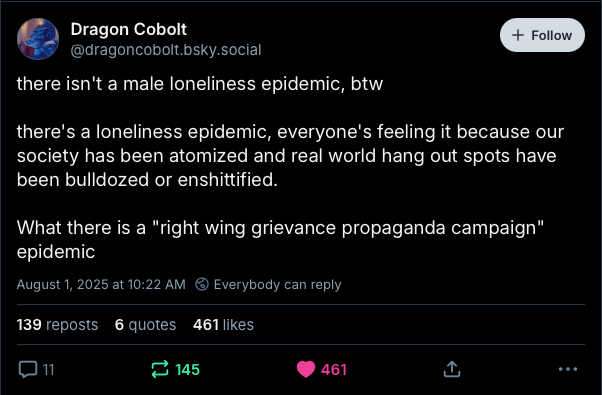
There’s an ongoing conversation on BlueSky about masculinity right now and I’ve weighed in here and there on the discussion, but the format is not really the best for complex thoughts. It’s moments like this when I remember, “Oh hey, I have a blog!”
Ian Dunt wrote and posted a piece on his substack about masculinity and “how to be a man” today, which spurred a broader conversation about male isolation and loneliness across BSky. I’d highly encourage you to read his essay because it’s, honestly, not bad! I think Ian gets the fundamental cause/premise wrong, but what he does talk about he gets right.
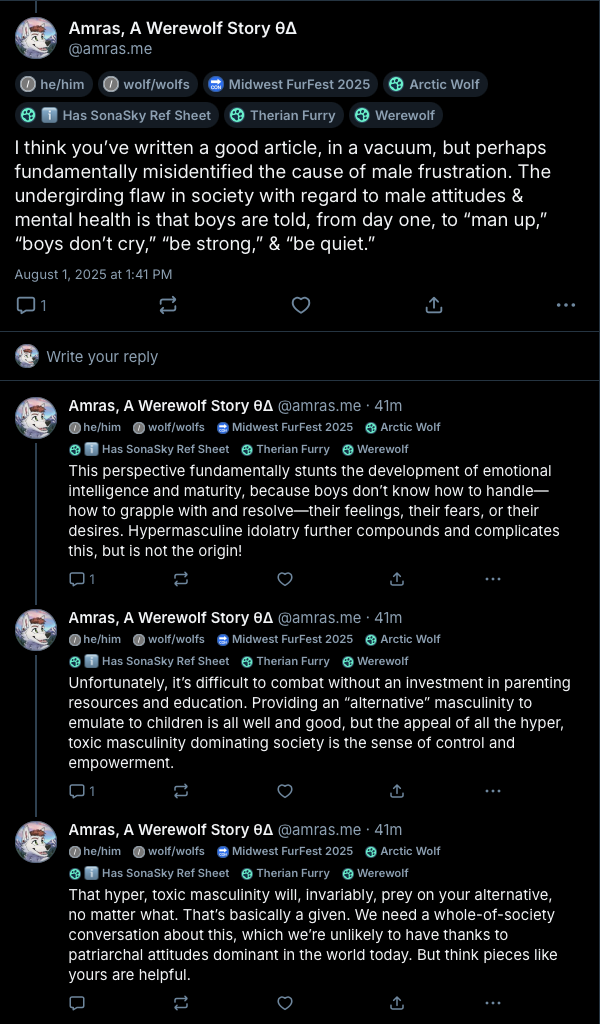 As I said in my response comments to his BSky post, there’s an even more fundamental cause behind male isolation than “men want to have sex.” It’s that boys—not men, little boys—are taught, from a very, very young age, that feelings are not to be spoken about or examined, wrestled with, or resolved equitably. Boys are taught that girls must be handled and interacted with as though they are delicate and lesser than they are, which sets little girls on a pedestal and frames the boys themselves, to themselves, as flawed, dangerous, and harmful. Boys are taught love is finite and must be earned, that they should never cry or show any emotion, and that every interaction in life is a competition. (They’re also taught that their body, and especially their penis, is shameful and should never be touched, discussed, or looked upon by themselves or anyone else. And if you do, it’s gay (derogatory).) I know this because I grew up as a boy; I have talked about this at length with my friends who grew up as boys—and as girls; and I have witnessed my friends, family, and colleagues do this, in real time, to their boys.
Courtney Milan, also responded, off thread, with her equally valid, wonderfully succinct, and accurate view that the cause of male loneliness is “[…] because [men have] been taught that a wife is a status symbol, not a person […]” This perspective, I feel, confirms part of my hypothesis: little girls are objectified and enfeebled in the minds of little boys by adults. Which, of course, connects pretty well with the idea from Dunt that male loneliness stems from the desire for sex and the pernicious ubiquity of hyper-masculine “alpha males” in popular culture and media. But neither of them connect to the rest of my hypothesis: the cause of male loneliness and isolation is a lack of emotional intelligence and maturity. The connection’s there, but no one else mentions it. (At least not that I’ve yet seen!)
If you’re not quite seeing the connection yet, let me mansplain it a little more for you… 😝
Little boys are taught by their parents to be little (construction, business, academic, physician, etc.) men instead of being allowed to be adventurous children, just as little girls are taught to be little mothers and home keepers rather than being allowed to be adventurous children. This pigeonholing of children’s emotional and intellectual development facilitates the lesson plan I outlined above: love and affection are zero-sum; every situation in life is competitive rather than collaborative; and emotions are for the women and girls, not for men.
It’s because of these “Laws of Manhood” that little boys grow up to become emotionally-stunted, lonely men. Dunt goes further and connects this adolescent loneliness to hyper-masculinity and poor role models, which I think is especially apt.
Dunt observes that lonely teens search and reach out for role models, inviting in assholes like Andrew Tate and Joe Rogan to fill the role model void. It’s these “men” they adopt as idols that further poisons them and puts them, he posits, on the path to become lonely men. These “alpha males” (idiots) are the ones who tell boys that the only way to be a “man” is to have a high-paying career, a hot wife, and carbon-copy children who also fit the trappings of the patriarchy. Without any one of these achievements, men are not “alpha males” but, instead, “beta” or “sigma” males. Without all three of them, “omega” males or worse—effeminates.
In the binary system that adults have constructed for children to grow up into, for a male there is nothing worse than to be perceived as female. Even gay male culture holds up this paradigm in the way “bottoms” are treated by most “tops.”
On the contrary, in the world I travel at least, there’s nothing more masculine than being able to grapple with ones feelings and communicate those feelings to others. Sure, there’s a lot of other stuff that ticks the “masculine” box on the checklist of characteristics, like strength, resilience, preparedness, and a glistening hot body, but being able to communicate your feelings? An ability to resolve differences through deescalation and compromise? That’s manly!
 I think that we’ve done a collective disservice to the future generations by trapping them in the same machismo that grew out of post-WWII, Vietnam era and the Cold War. Children need to be free to explore their feelings, to experiment with and experience things outside of “traditional” gender roles. If boys want to learn to cook or sew, great! If girls want to play with Tonka Trucks or microscopes, awesome! And they should be encouraged to do so at every opportunity.
Without this allowance, we—adults—create an uphill struggle for each and every child who wants to reach for and accomplish goals historically dominated by the opposite gender(s). And while I disagree with Dunt that the solution to the problem is simply an alternative role model culture for boys and an open discussion about sex—which I fully support and appreciate as critical elements of a solution—I think the real panacea starts and takes place much earlier. Stop teaching little boys they shouldn’t cry, that they can’t collaborate, and that they are incapable of loving or being loved! Stop telling children that they must earn love, that they can’t pursue their unique interests, and that they should be ashamed of their bodies. Stop putting little girls on pedestals above boys. Stop telling little boys that girls are fragile. Celebrate and lift up alternative role models for boys, teens, and men as a counterpoint to and replacement for the Tates and Rogans. Talk with children and adolescents, earnestly and seriously, about sex!
Masculinity is not limited to stereotypes! That’s toxic, hyper-masculine, patriarchal thinking.
Masculinity is as broad and diverse as femininity, it must needs be! It’s being a good father, uncle, son, cousin, and/or friend; a good husband or partner; a good community leader. Masculinity is strength of character! It’s music and art; it’s emotional maturity and expression. Masculinity is conviction, purpose, and an ability to learn from one’s failures. And none of it takes away from the masculinity of another man because it’s not a competition.
In the end, I think Cobolt is probably the most correct of all of us.