WARNING: This essay is focused on comparative anatomy as it relates to the Furry fandom and the art produced therein. If you don’t like Furries and/or don’t think you can stomach discussions of pelvic anatomy—and the related holes associated with mammalian bodies—you should just skip this post entirely.
There seems to be a lot of confusion among Furry artists about where to place buttholes, scrotums, vaginas, and tails in their illustrations. And a lot of confusion leads, inevitably, to a lot of really… creative solutions with regard to placement. Now, I’m not going to sit here and tell anyone they’re “wrong” in how they depict fantastical, imaginary anatomy, but I do want to share some thoughts on the topic because—as a Furry—I value structural realism and functional accuracy.
Quadrupeds
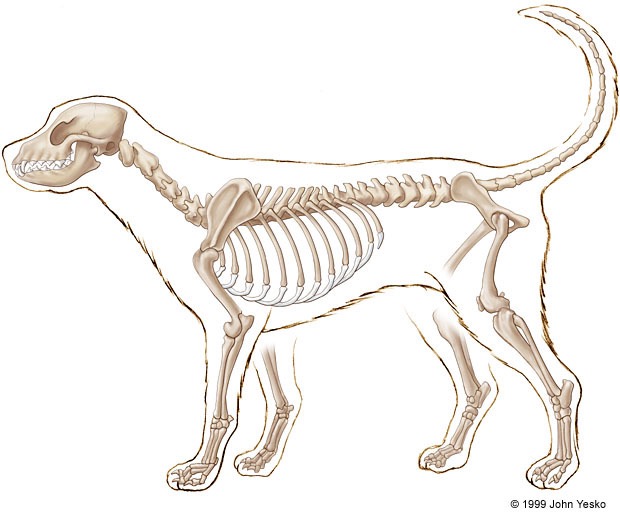 Let’s start with real-life, quadrupedal mammals. It is important to start by examining pelvic structure and the attachment of both the spine (backbone) and the tail to the pelvis. For the purposes of this essay, we’ll focus on canines—I’m making this choice primarily because I’m a wolf and, for whatever reason, canine veterinary anatomy is more readily available in online image searches than most other common species within Furry—but you can easily extrapolate to felines, equines, ursines, etc. from there.
Take a look at the image to the right, it shows the canine skeleton, and you’ll see that the tail continues from the pelvis along the same axis as the spine.
The pelvis is the base attachment point for the spine, which then continues through the pelvis—via the sacrum—to the tail, no matter how short the tail is. As the tail extends past the pelvis, it extends from the bottom/end of the sacrum, that is the tail’s attachment point. The tail does not extend at 90º from the pelvis in any species, as such it is not perpendicular to the spine!
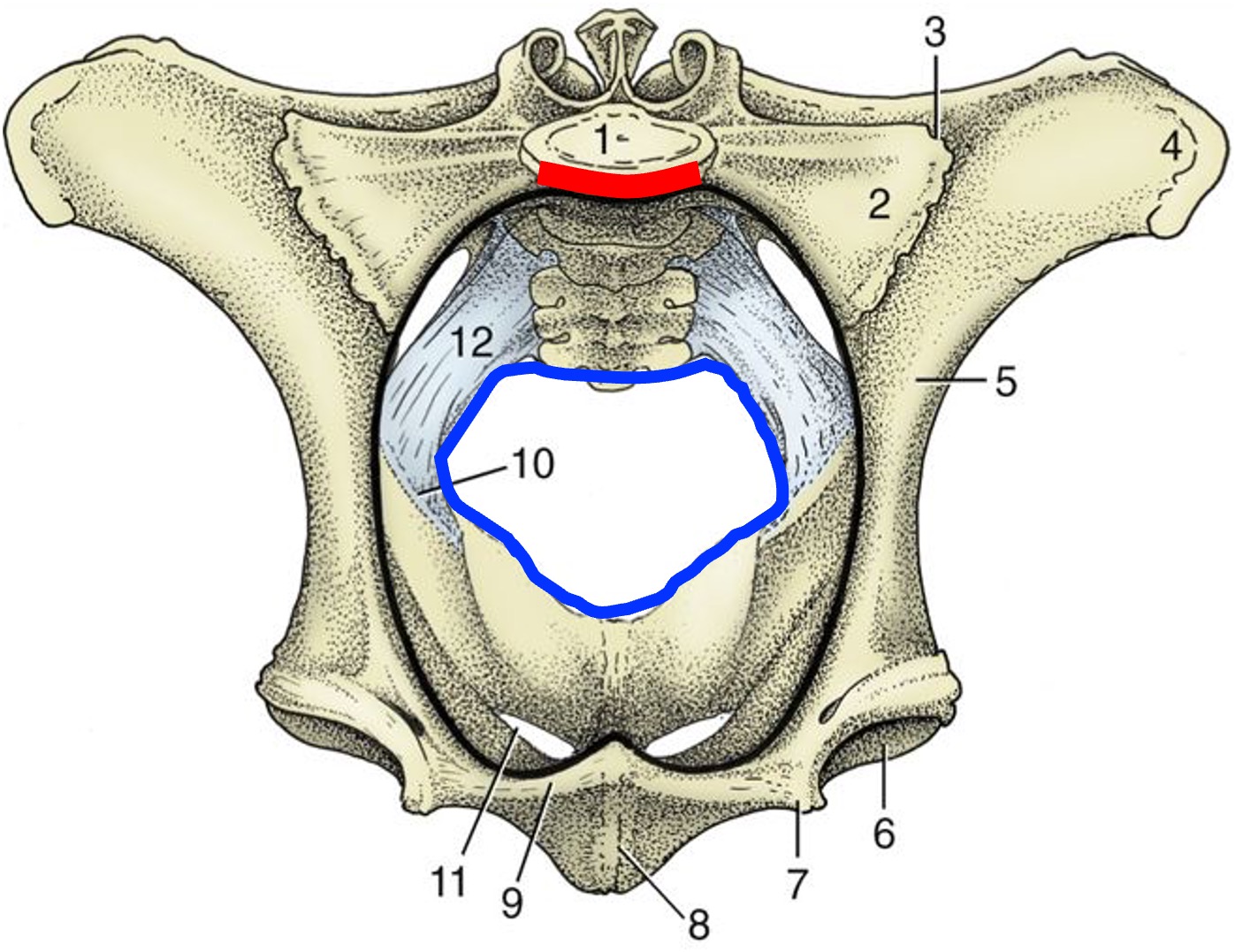 Because of this connective positioning, the tail should be depicted attaching to the body below the sacrum (12)—which are the fused vertebrae that attach the spinal column to the pelvis—and not at or above it. Similarly, because the colon and vaginal canal both pass through the pelvis, the anus and vagina are positioned immediately below the tail and at the bottom of the pelvic ring (indicated by the blue line in the image to the right), respectively.
The scrotum, contrary to many depictions, attaches to the body on the underside and back of the pelvis, near the obturator foramen (11).
Although the shape of many bones may be different from species to species, because mammals share the same skeletal structure, these locations are the same in bipeds—like humans—which allows us to extrapolate positional and functional anatomy from quadrupeds to bipeds.
Bipeds
Again, we’ll start with the pelvic structure, in this case of humans, and identify the same structures and locations as before.
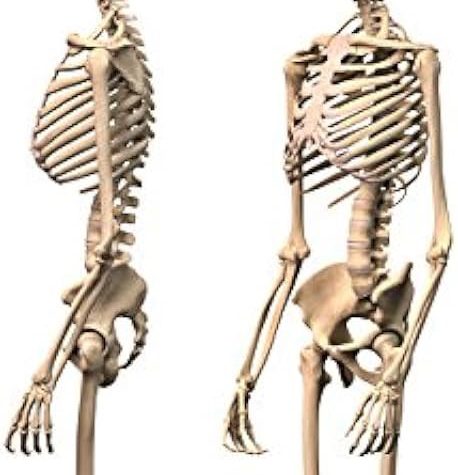 Looking at the image to the right, you’ll see that the spinal column attaches to the pelvis vertically, and then the tail, or “coccyx,” continues below the pelvis. This is the same relationship between pelvis, sacrum, and tail as seen in quadrupeds. You can also clearly see that the tail, or “coccyx,” extends down, below the sacrum, on the same axis as the spinal column just as we saw in our canine example above.
Again, the pelvis is the base attachment point for the spine, which then continues through the pelvis—via the sacrum—to the tail, no matter how short the tail is. As the tail extends past the pelvis, it extends from the bottom of the sacrum, that is the tail’s attachment point. The tail does not extend at 90º from the pelvis in any species, as such it is not perpendicular to the spine!
Because of this connective positioning and, again, because the colon and vaginal canal both pass through the pelvis, the anus and vagina are positioned immediately below the tail and at the bottom of the pelvic ring (which, in this case, is more towards the front of the body).
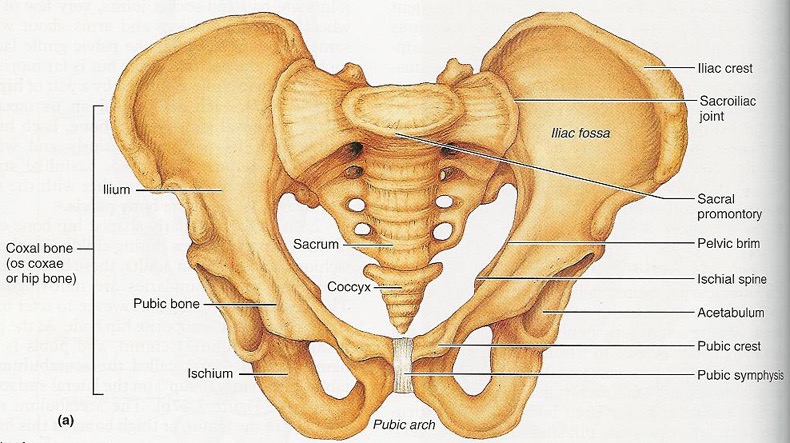 In bipeds, such as humans, the scrotum attaches to the body near the pubic arch, and is thus positioned at the front of the body, but it is essentially in the same place as in quadrupeds.
An important thing to remember is that humans have tails, they are extremely short and the vertebrae are fused together to form the “coccyx.” But that’s the tail! It’s there. It even has vestigial muscles and tendons attached to it.
Anthropomorphic Animals
When illustrating anthropomorphic animals, or “Furries,” one should take care to depict the structural anatomy accurately. That means the tail attaches at the bottom end of the sacrum, below the top of the pelvis, and the anus/butthole is immediately below the tail. This will give your anatomy a more realistic and functional feel.
Most often, I see Furry artists depict the tail attachment at or above the sacrum, which is just wildly incorrect and means that the anus is either too high or oddly too far from the base of the tail. This just looks weird! But when you get it right, it’s golden!
Now, I’m not going to sit here and put anyone on blast for getting the tail positioning wrong, so don’t expect to see any examples of what I’m calling out. But always remember: spine -> sacrum -> tail. If you remember this and depict it accurately, you’ll be able to position the anus, vagina, scrotum, and penis more reliably and accurately in all of your NSFW drawings. And, hey, if you don’t draw NSFW art, that’s fine! Remember it for your SFW work, too! Because the proper tail positioning is important regardless of whether or not you’re including genitalia.
If the tail connects at the top of the sacrum, that means the spinal cord doesn’t enter into the pelvis, which would mean that the legs have no nerves in them. And legs without nerves can’t walk. So… let your Furries walk.
Thanks for coming to my silly TED talk about realistic pelvic structure in fantasy characters.


